Wednesday, 1 August 2018

My Drama With Hasselblad, Bullying, and Their Latest Comparisons
As a photographer and YouTuber, I review equipment and photography related gear on my channel. There are occasions when certain items receive less than positive reviews and, in most circumstances, the company in question operates in a very professional manner. Unfortunately, this isn’t true in every case and after I reviewed the Hasselblad H6D 100c, Hasselblad weren’t too happy with me.
It was early last year when I reviewed the flagship Hasselblad camera comparing it to several full-frame cameras and an iPhone. Initially, Hasselblad were fine with the reviews and actually gave me more equipment to test and review. It wasn’t until my videos were featured here on PetaPixel that they started to have some issues with the videos.
Staff members and representatives from the company started hurling insults and personal attacks in my direction instead of discussing any of the points I raised. Comments like “you’re stupid” and “you’re foolish” and statements about how this will ruin my reputation and damage my career were thrown around.
Hasselblad also discussed how they were planning to produce their own videos to demonstrate how their cameras “actually” perform. As far as I’m aware this is not something Hasselblad has ever done previously and at the time I welcomed it. What’s crazy is that up until the insults, I was still strongly considering buying a Hasselblad camera. I even mentioned this specifically in my video.
Eventually, these comments and insults subsided for some time until I was at The Photography Show earlier this year in March. I was attending with a press pass and towards the end of the first day, I walked past the Hasselblad stand and politely waved at some of the individuals I recognized. We had a brief discussion and although they made some comments, we eventually shook hands and called it “water under the bridge”. They asked if I were attending on any of the other days because they wanted me to meet some people.
I arrived again on Monday and as agreed, I visited their stand where I was met with some of their representatives who immediately started to try and intimidate me. The insults came pouring out again, the individual stood very close and directly in front of me. I realized in that moment that Hasselblad had essentially called me over again just so some of their representatives could intimidate and berate me. This I consider to be bullying.
Hasselblad is quite obviously a much larger organization than I am and it seems they’re trying to use that to their advantage. I assume they’ve taken my review very personally, hence the intimidation, insults, and the fact that they’ve decided to upload video comparisons of their own. Once again this isn’t something they’ve done previously, and in some sense, it’s somewhat of a compliment to me.
Speaking of their comparisons, their latest videos are blatantly unfair.
These videos they’ve uploaded are essentially puff-piece ads produced by ambassadors that have no incentive to be objective. They compare their 28mm prime lens against the Nikon 17-35mm zoom, which is also quite an old lens. To make matters worse, they compare both lenses at different focal lengths, but they shoot them both at the same aperture, f/16. This is a clear attempt to handicap full-frame in order to serve their narrative. The full-frame lens produced a noticeably greater depth of field and only needed to be stopped down to f/10 to achieve the same as the Hasselblad.

In the video, they also discuss how the Nikon image is much colder while using a custom white balance on both images. They’ve clearly attempted to cripple the performance from the full-frame camera to make their system look better. I’ve demonstrated how in a fair comparison their system cannot compete with some of the best lenses available for full-frame. Maybe they’re aware of this fact and that’s why they resort to these methods. Their lenses are simply incapable.
Their videos only demonstrate a severe lack of confidence for their own cameras. If they actually believed their system was the best, they would actively aim for fair and level comparisons. In fact, if they were truly confident in their system, they would offer up advantages to the full-frame camera just to show how good their system is. Clearly, this is not the case.
It’s disappointing to see a company like Hasselblad operate in this manner. They hold a prominent position within the photography community and have in the past offered some of the best cameras on the market. Their current camera body feels cheap and dated and their lenses are not up to current standards.
They are in dire need of an update and instead of bullying, intimidating and producing unfair comparisons, maybe they should take heed of the points being raised in reviews. These latest comparisons from them have effectively bolstered my points. Fortunately, the dislike bar and the comments on their video demonstrate how a vast number of individuals are not falling for these tactics.

Editor’s note: We reached out to Hasselblad for comment prior to the publication of this article, and here’s their response:
Hasselblad takes the points that Mr. Dawood raised very seriously. We are investigating internally and express our apologies to Mr. Dawood for his experience. We have already reached out to Mr. Dawood to further understand the experience he has had and look forward to improving the conversation.
Hasselblad values and encourages an open conversation and dialogue in the photography community. We respect Mr. Dawood’s opinions in response to our content, alongside the opinions of any person who, like us, are deeply committed to the art of image making.
About the author: Usman Dawood is the lead photographer of Sonder Creative, an architectural and interior photography company. The opinions expressed in this article are solely those of the author. You can find more of his work on his website, Instagram, and Twitter.


from PetaPixel https://petapixel.com/2018/08/01/my-drama-with-hasselblad-bullying-and-their-latest-comparisons/
Wim Wenders: Phones Have Made Photography ‘More Dead Than Ever’
Renowned German photographer and filmmaker Wim Wenders thinks that photography “is more dead than ever” and that smartphones are to blame for the art form’s demise. In this 1.5-minute video produced by BBC News, Wenders stops at an exhibition of his Polaroid photos to share some of his thoughts on the current landscape of photography.
Wenders believes that part of the devaluation of photography comes from the fact that even though so many more photos are being captured every year, so many fewer photos are being treasured and enjoyed in the way they were before.
“The trouble with iPhone pictures is nobody sees them,” Wenders says. “Even the people who take them don’t look at them anymore, and they certainly don’t make prints.”
And even though phones are getting loaded with more and more features and filters, they may not be helping people become creative photographers.
“I know from experience that the less you have, the more creative you have to become,” the photographer notes.
Basically, Wenders doesn’t think very highly of the smartphone’s place in the world of “serious” photography, and he doesn’t even think that most picture-taking done on smartphones should even be called ‘photography’…
“I’m in search of a new word for this new activity that looks so much like photography but isn’t photography anymore,” Wenders concludes.


from PetaPixel https://petapixel.com/2018/08/01/wim-wenders-phones-have-made-photography-more-dead-than-ever/
Steadify is a Camera Stabilization Belt That Turns You Into a Tripod

Want a way to steady your camera without having to haul a tripod or monopod around? Are tripods banned in the location you’d like to shoot? Steadify is a strange-looking camera stabilization belt that’s designed just for you. The slogan for the product is: “You are the tripod.”
After putting on the belt, you extend the aluminum monopod hanging from under your belly button with a single twist to lock and unlock it at your desired length. Rather than mount your camera to it using a standard tripod mount, the end of the Steadify monopod features a fork-shaped mount that allows it to stabilize any kind of device while the user pans and tilts it in any direction.

The fork mount also allows the device to be used for stabilizing other non-camera products as well — things like binoculars, scopes, and guns.
The German-designed Steadify also serves to redistribute the weight of your camera onto your body and legs, allowing you to shoot with heavier cameras and lenses for extended periods of time with less fatigue.

“Steadify also functions as a jib arm for smooth vertical and horizontal camera movements, a bonus usually found in more lavish equipment,” the company says. “For cameramen, this feature adds life and dynamic to footage that can make a scene stand out.”
And if you wear the Steadify, you’re obligated to show it off to others by giving it this kind of reveal:

Other features of Steadify include a steel-ball head, magnet-supported retraction, a leather baseplate with Nylon belt, a weight of just 1lb (0.5kg), and a maximum length of 31.5in (80cm).

Although Steadify has already been available in Amazon’s “Sports & Outdoors” and “Hunting” categories with a price tag of $129, the company is currently running a Kickstarter crowdfunding campaign to get the product into the hands of photographers.
The Steadify is being offered in three different looks:

The early bird prices of $99 and $129 are running out for the standard Steadify and bundle (with a quick-release ball head and pocket clip), and everyone else can get one for the higher price of $139 in the campaign (though it would probably make more sense to order it from Amazon instead and receive it immediately instead of waiting for the October delivery date).


from PetaPixel https://petapixel.com/2018/08/01/steadify-is-a-camera-stabilization-belt-that-turns-you-into-a-tripod/
Canon is Already #1 in Mirrorless Cameras in Japan

Sony has multiple full frame mirrorless cameras on the market and Nikon is planning to unveil its first later this month, but it seems that having a pro-oriented mirrorless camera isn’t a prerequisite for doing well in the mirrorless market. Case in point: Canon is apparently already the #1 mirrorless camera company in Japan even before announcing its own rumored full frame mirrorless system.
Canon Rumors reports that in reporting its 2018 2nd quarter financial results recently, Canon claims that it has taken the #1 spot in mirrorless camera market share over the first half of 2018.
The APS-C Canon EOS M50 is apparently selling well enough to the masses to beat out the technologically impressive cameras by competitors such as Sony (which won “Camera of the Year” for the a9).
Currently priced at $629 for the body only or $699 with a bundled 15-45mm kit lens, the EOS M50 competes against other affordable mirrorless cameras and entry-level DSLRs in targeting casual photographers and the general consumer, and it enjoys the advantage of having Canon’s long-established brand recognition in the photo world.
“In the second quarter, sales were driven by the EOS M50, a strategically positioned mirrorless camera,” Canon states. “Despite being an entry-class model, it incorporates features found in more advanced cameras while delivering easy operation for beginners. Through this, we are bringing new users into our ILC ecosystem.
“Through the launch of these types of new products, for the first half, we have secured the top market share position for mirrorless cameras in Japan and are steadily increasing our market share position in other regions.”
Canon says it will further strengthen its camera lineup by announcing new products in the second half of 2018. Canon already said that it’s willing to cannibalize its DSLR business to gain further mirrorless market share, and with Nikon’s new full-frame mirrorless system just around the corner, Canon’s announcement is likely coming soon as well.


from PetaPixel https://petapixel.com/2018/08/01/canon-is-already-1-in-mirrorless-cameras-in-japan/
Five (More) Uncomfortable Truths About Photography
One of my first articles here at DPS was entitled 5 Uncomfortable Truths About Photography. I wrote it as a reality check to myself, and for you, the readers of DPS. Our beloved art of photography has a dark side, and it’s important to recognize this. In the couple of years since I penned that piece, a few more negatives about our art have occurred to me, so I figured it was time for Part II.
#1 – Bad Weather is Good Weather

I’ve recently returned from leading a wilderness trip in Alaska’s Northwest Arctic. My group and I spent 11 days canoeing on a very remote and wild river. For the first three days, the weather absolutely sucked and it was glorious. But then the sun came out and it all went downhill from there.
When it comes to outdoor photography, the bluebird days we hope for as hikers, paddlers, cyclists, and explorers, are not ideal. Bright blue skies do not create drama. They don’t catch the evening light, and they don’t roil and boil in textures of deep blues and grays.
Now a good storm, that’s dramatic!

Without the moody skies here, the warm tones in the rock would be either absent or much less compelling.
Our small bush plane slipped in beneath low clouds, barely clearing the pass over the mountains. We landed in a mix of blowing snow, sun patches, and a cold north wind. Photographically speaking it was perfect weather; a constantly shifting drama unfolding across the landscape.
For a few cold and blustery days it was perfect, and my best images of the trip were made during that time. But, on the fourth day, the wind shifted and blew out the clouds and snow, leaving behind a bluebird sky, warm temps, and sunshine. It definitely could have been better for photography.

This image and the one below were made 24 hours apart but from very nearly the same location. This brooding, moody, stormy weather is far superior to the more generic, nice-day image below.
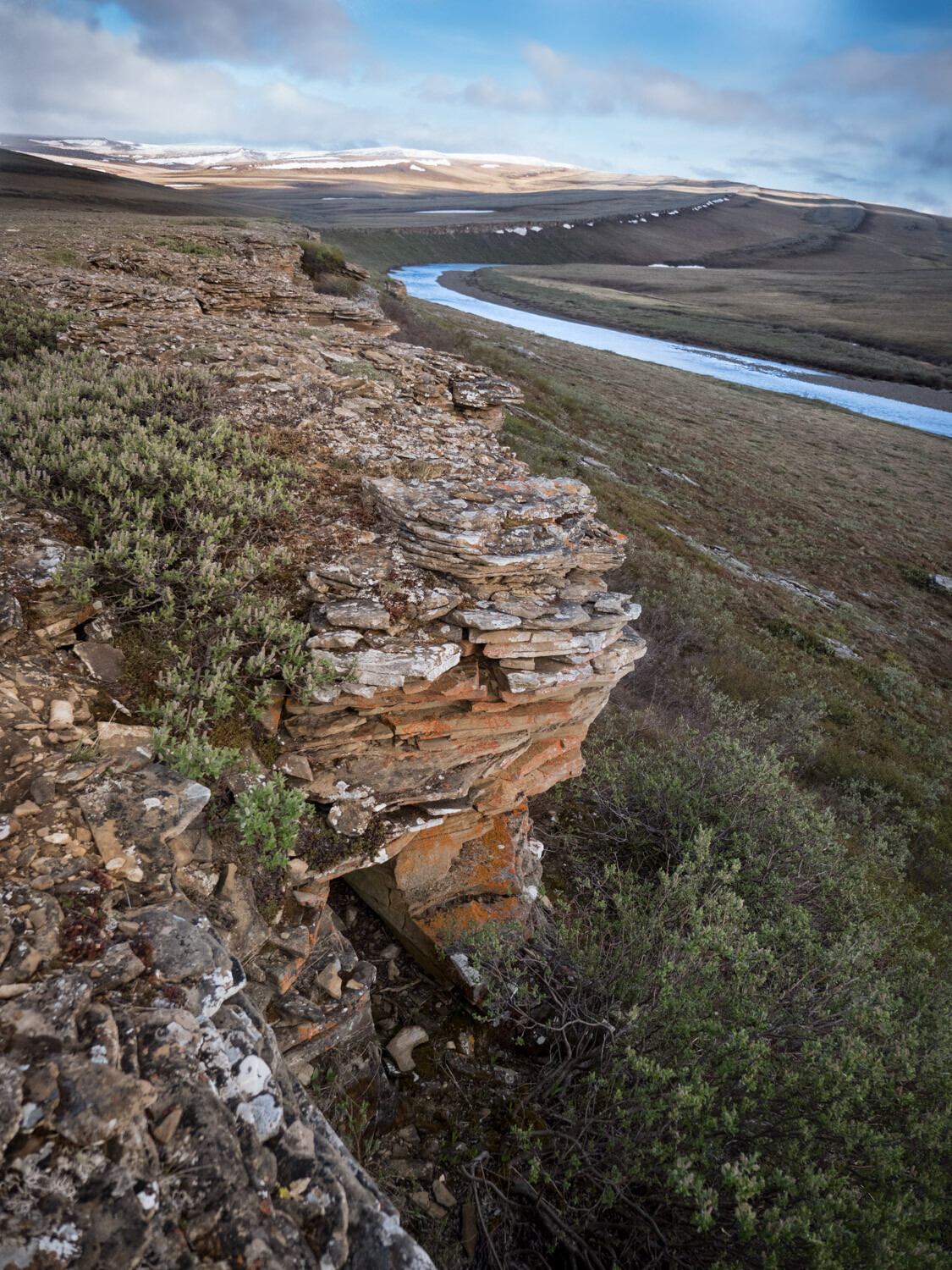
The moral of the story is that the best weather for being outdoors is often boring when it comes to photography. So be brave, and step outside even when it’s snowing sideways.
#2 – Lens Snobbery is Real

A Swainson’s Thrush singing in my yard in Fairbanks, Alaska. This image is one I could never have captured with my old 500mm f/4 simply because I simply would not have been carrying it while walking my dog.
A few months ago I made the heart-wrenching decision to sell off my beloved Canon 500mm f4L IS lens. It was a hard decision. That big hunk of glass and metal had been with me a for a few years, traveled around the world with me, and made some of my best images. But, its size, heft, and cumbersome, tripod-requiring handling was getting in the way.
I’ve replaced it with a much smaller Olympus 300mm f4 PRO for the micro 4/3rds system (giving me a 600mm f4 equivalent at a third of the size). And here is the uncomfortable part – the quality of the Olympus lens is equal to that of the Canon and I don’t miss the bigger, more expensive Canon lens at all. Not one little bit.
Except (and to be honest I have a hard time admitting this) when I’m around other photographers. As a bonafide professional shooter, the big lens felt like a badge of honor. It’s a bogus badge for sure because the size of your lens has nothing to do with performance or image quality. Yet I felt like I needed that big glass to be taken seriously as a pro.

I don’t think the bokeh or sharpness of my Olympus 300mm f4 falls short in any way when I compare it to larger, far more expensive lenses like my old 500mm f4.
The compact mirrorless 4/3rds system does not stand out the way the big gear did, and in groups of photographers, I noticed my gear (and me) being brushed over.
The great irony is that my long lens work has improved dramatically with the purchase of the new gear. Its small size is easy to transport, so it is always with me when it matters. I now walk the dog with a 600mm f4 equivalent for heaven’s sake! It’s there when I need it and the results have been excellent.
Time to put the snobbery aside and let the images speak for themselves.
#3 – Your big DSLR is Unnecessary

Yesterday, while wandering around my local farmer’s market, I saw a photographer shooting with the exact same Canon professional level DSLR I owned until a few months ago. My god, it looked huge!
You see, I’ve recently switched from Canon to Lumix (for general shooting and wildlife) and Sony for night work and high-resolution landscape imagery. Both of these two mirrorless systems cast a tiny shadow compared to the hulking DSLRs of my past life.
In this day and age, the difference in quality and performance between a big DSLR and a light and compact mirrorless is precisely zilch. The big camera may make you stand out in a crowd (see #2 above), but it won’t make better images.
#4 – Creativity is More Important Than You Think

Part of creativity is knowing when to grab a shot. Rather than pausing when the headlights of a big truck fell across this mountainside, I experimented with an exposure.
Look across the pages of any photo website or magazine and you’ll see gobs of articles and tutorials about camera settings, focus techniques, equipment, exposure, and post-processing. But likely you’ll find very few about the creative process of image making.
I know why. These types of articles are popular because they offer simple, actionable things to learn that can improve your images quickly. Don’t get me wrong, these things are super important to know. But all the settings, equipment, and post-processing tips are merely tools in your toolbox, not the final product.

Eventually, every serious photographer reaches a point where they know all they really need to know about their camera and computer programs, and then what…? They either realize that that photography is more than a technical craft and they begin looking at it from a creative perspective, or they don’t, and they stall out.
Learning the technical details is easy compared to actually finding and composing images in the field. Good photography is not formulaic, and how do you learn something that doesn’t use a formula for success? You work at it, a lot. It’s hard and uncomfortable. That’s how.
#5 – Money is Better Spent on Travel than Gear

For much less than the price of a new pro-level camera body, you could go photograph something like this.
Got a few hundred bucks to blow on gear? Don’t. Take that few hundred bucks and take a few days and go somewhere awesome instead. Unless you really need it, your extra money is better spent on going somewhere really cool to make images, and not on cameras, lenses, bags, filters, and flashes.
I can just about promise you that you’ll get more and better images by a few days of travel to photograph wildlife, or landscapes, or the northern lights, or some new city than you will by spending the same amount on a new piece of kit.

A trip to Africa last year re-inspired me in a way a bunch of new gear never could.
A new telephoto lens or camera could cost you thousands of dollars. If you have functional camera gear, and you are looking at something new just because it’s all bright and shiny, take a moment to reconsider. Could those thousands be spent traveling somewhere new and unique? Some place to photograph a landscape or phenomenon you’ve always dreamed of shooting?
We make images by exploring our world. Without that exploration, all the fancy new gear in the world is worthless. Just as importantly, you’ll get the experience and joy of travel, and that is truly priceless.
Conclusion

Look, photography is messy and expensive. I suggest you embrace the mess and reassess the expense. Go outside when the weather sucks and see what you find. Remember that the performance of your gear is what matters not the brand or the size, and know that creativity is hard but it’s the only way to advance your photography. Photography takes work.
Lastly, think about how you spend your money. Old glass and old cameras often work just fine, and are capable of producing excellent images. Maybe you should hold onto that gear for a while longer and spend some of that extra money to go somewhere new. Travel, you’ll find, is an excellent strategy for making great photos.
It’s an uncomfortable photographic world out there. So it’s time to accept it, and go make something beautiful.
The post Five (More) Uncomfortable Truths About Photography appeared first on Digital Photography School.
from Digital Photography School https://digital-photography-school.com/five-more-uncomfortable-truths-about-photography/